
1. How Does Generative AI Work? (A Simple Analogy)
Generative AI is a type of artificial intelligence that can create new, original content—such as text, images, music, or videos. It does this by learning patterns from massive amounts of existing data and using that knowledge to generate fresh material that resembles human creativity.
It might sound complicated, but the big idea is easier to grasp with a simple analogy.
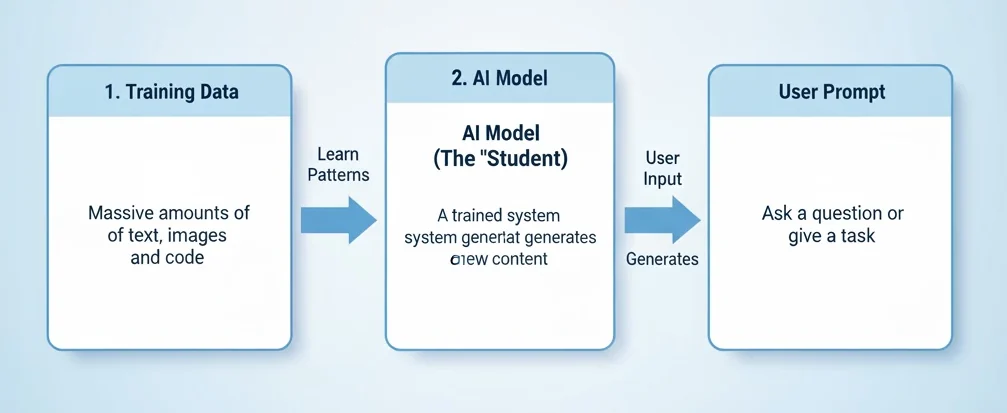
Imagine a student who has read millions of books, articles, and lines of code, paying close attention to how ideas connect. This is called training — the process where the AI learns patterns and relationships from massive amounts of information, known as training data.
Once trained, the student is tested on both familiar and brand-new examples. If they perform well, they’re ready to work as a personal advisor — your AI assistant.
When you ask a question or give a task (called a prompt), the AI searches through everything it has learned, finds the most relevant knowledge, and creates an original answer. The “student” that does all this is called the model — the trained system that generates new content.
2. What Are Some Common Examples of Generative AI?
Generative AI shows up in more places than most people realize. Here are five common applications, including some popular platforms for each.
2.1. AI Chatbots and Writing Tools
These large language models (LLMs) understand prompts and generate human-like text. They can write emails, articles, assist with customer service, and summarize content.
- ChatGPT – AI assistant from OpenAI.
- Google Gemini – Google’s multimodal AI models.
- Claude – AI assistant from Anthropic.
- DeepSeek – AI model focused on coding and tech research.
2.2. AI Image Generators
Text-to-image models create original pictures from brief text descriptions, widely used by artists, designers, and marketers.
- Midjourney – Known for artistic and realistic styles.
- DALL·E 3 – OpenAI’s image model, integrated with ChatGPT.
- Leonardo.Ai – Platform offering a suite of generative AI tools for creative assets.
- Adobe Firefly – Generative AI in Photoshop and Creative Cloud.
2.3. Music and Sound Creation
These AI systems compose music, soundtracks, or audio clips in various styles, often from text prompts.
- Suno – Generates songs with vocals from text prompts.
- AIVA – AI music composer for films, commercials, and games.
- Mubert – Generates royalty-free music for content creators and brands.
2.4. AI Video Generation
AI models produce video clips, animations, or special effects from text prompts. This technology is rapidly evolving.
- Google Veo – High-definition video generation model from Google.
- Runway – AI video editor with text-to-video models like Gen-2.
- Pika – Platform for creating and editing videos with AI.
2.5. AI Code Assistants
AI tools that help programmers write and understand code. They suggest lines, complete functions, explain code, and help find bugs.
- GitHub Copilot – AI code assistant from GitHub and OpenAI.
- Gemini Code Assist – Google Cloud’s AI assistant for developers.
- Amazon Q Developer – AI assistant for building and operating applications on AWS.
- Sourcegraph Cody – AI assistant that understands your codebase.
- JetBrains AI Assistant – Built into JetBrains IDEs like PyCharm and IntelliJ.
- Tabnine – AI code completion tool, can run securely on-premises.
3. What’s the Difference Between Generative AI and Regular AI?
The primary difference between Generative AI and “regular” AI (often called Analytical AI or Predictive AI) lies in their core purpose. Regular AI analyzes existing data to make a prediction or classification, while Generative AI creates entirely new, original content.
3.1 How Do They Work? (A Simple Analogy)
Think of it like this: Imagine an AI system trained on thousands of examples of text or images.
- The Regular (Analytical) AI acts like a judge. It looks at a new input and provides a single, final decision based on what it learned. For example, it might classify an image as “cat” or “dog.” The prediction is the final answer.
- The Generative AI acts like an artist. Its job is to create something new. For instance, it could generate a brand-new, realistic-looking image of a cat. It uses patterns it learned to produce original content that fits the prompt.
3.2 A Common Question: Isn’t Generative AI Just Prediction?
Yes, at its core, a Generative AI model predicts the next element—like the next word in a sentence. But the key difference is in the process.
- A Regular AI makes one prediction, and that is the final answer. The process stops there.
- A Generative AI uses each prediction as a step in an autoregressive loop. It predicts an element, adds it to the prompt, and predicts again. Repeating this builds complex, original content from a simple start.
So while regular AI answers a question, generative AI can create something entirely new from learned patterns.
| Feature | Regular (Analytical) AI | Generative AI |
|---|---|---|
| Core Purpose | Analyze & Predict | Create & Generate |
| Analogy | The Judge | The Artist |
| Output | A classification (e.g., “Cat”) | New content (e.g., A new photo of a cat) |
| Example | Spam Filter | AI Chatbot (ChatGPT) |
4. Why Is Generative AI Important?
Generative AI is important because it represents a fundamental shift in how we create, innovate, and automate. It moves artificial intelligence from a passive tool for analysis to an active engine for content creation. This transition has profound implications for both productivity and creativity.
- Massive Efficiency and Productivity Gains: By automating complex and time-consuming tasks, generative AI acts as a powerful accelerator. As seen in AI code assistants and writing tools, it can draft human-like text, generate software functions, or summarize dense information in seconds. This allows professionals to bypass manual work and focus on higher-level strategy, design, and problem-solving.
- Democratizing Creativity: This technology breaks down high-skill barriers. AI image, music, and video generators empower anyone to produce high-quality, original content from simple text prompts. It serves as a creative partner, helping artists, marketers, and designers explore novel ideas and dramatically speed up their workflows.
- A Critical Limitation: Hallucinations and Trust: A key challenge is the technology’s tendency to “hallucinate.” Because models are designed to predict plausible content, not to verify truth, they can confidently invent facts or generate biased information. This makes human oversight and critical fact-checking essential for reliable applications.
5. The Future of Content Creation with Generative AI
Generative AI marks a pivotal moment in technology, fundamentally changing our relationship with digital creation. It moves beyond simple data analysis to become an active content generator. As we’ve seen, this technology is built on large-scale models trained on vast datasets, enabling them to understand complex prompts and produce original, human-like text, code, images, and media.
The key takeaway is the shift from AI as a “judge” (Analytical AI) to AI as an “artist” (Generative AI). While this unlocks unprecedented efficiency and democratizes creativity for everyone from developers to artists, it also introduces critical challenges, notably AI hallucinations—the model’s tendency to invent facts.
The future points toward even more sophisticated, multimodal models (like Google Gemini) that will seamlessly blend text, image, and audio generation. As this technology evolves, it will become a more integrated AI assistant and creative partner, amplifying human potential rather than replacing it. The focus will be on refining accuracy and building reliable, trustworthy human-AI collaboration.
AI is a tool. The choice about how it gets deployed is ours.
Oren Etzioni